
Complexity of Compliance: How Chief Bookkeeping Officer Addresses Unique Demands of Law Firm Bookkeeping in San Diego
For San Diego attorneys, the legal practice is a high-stakes environment where the strict fiduciary compliance of the CA State Bar meets the intense operational demands of a Southern California business. Standard, generic bookkeeping methods are simply not adequate for this hybrid industry. If your firm in the Greater San Diego Area is treating client retainers as immediate firm revenue or neglecting mandatory 3-way IOLTA reconciliations, you are operating with both ethical risks and a distorted financial view. Achieving true clarity requires specialized San Diego law firm bookkeepers who master the specific complexities of contingency fee settlements and the ethical necessity of IOLTA trust accounting in California. Here is how specialized oversight differs from the generalist approach:

Specialized Bookkeeping Service Pricing for San Diego Law Firms and Their IOLTA Accounts
Managing IOLTA compliance and client funds demands a level of precision and consistency that cannot be subjected to the uncertainty of hourly billing. Our specialized law firm bookkeeping is provided on a predictable fixed-fee basis, structured around the complexity of your practice, not fluctuating hours. Plans that include mandatory 3-Way IOLTA reconciliation and full monthly oversight start at:
$699.00 per month
Our fixed monthly fee may change inline with your firm's matter and transaction volume.
Chief Bookkeeping Officer's Specialized Law Firm Accounting
Generalized
Bookkeeping
Governed by State Bar Rules
We operate with familiarity with Rules of Conduct 1.15 (Client Trust Accounts) and common jurisdictional requirements, allowing us to proactively structure your books to prevent errors that lead to compliance issues.
While generalist bookkeepers are proficient in standard business practices, they may not be fully versed in the specific ABA and State Bar Rules of Professional Conduct.
Performs 3-Way IOLTA Reconciliations
We conduct precise, monthly 3-Way IOLTA Reconciliations, matching the bank statement, the trust ledger balance, and the sum of all individual client ledgers to ensure funds are never commingled.
Standard bookkeeping often relies on a simple 'one-way' bank reconciliation. However, most State Bars require a rigorous three-way reconciliation, matching the bank balance, the book balance, and individual client ledgers, to ensure every cent is accounted for at the client level.
Manages Advanced Client Costs as "Assets"
We correctly track advanced client costs (filing fees, expert witnesses, etc.) as firm assets until the client reimburses the firm or the case settles. This provides an accurate picture of the firm's true profitability and assets.
We have encountered traditional bookkeepers treating advanced client costs as operating expenses therefore affecting the profit and loss by artificially reducing income.
Tracks Retainers as Client and Settlement "Liabilities"
We correctly classify and track all client retainers and fee advances as client liabilities on the Balance Sheet until they are officially earned and transferred, ensuring compliance with Rule 1.15.
A normal bookkeeper might book settlement deposits and retainers as income on your profit and loss therefore increasing revenue inappropriately.
Expertise in Contingency Fee Accounting
We specialize in setting up the appropriate accounting structure for contingency fee practices, properly recording and allocating large settlements and firm expense recoveries to prevent unexpected tax liabilities.
With a standard bookkeeping service, your firm's QuickBooks Online may be set up inappropriately to handle the receiving of settlements and then the disbursement transactions related to settlements.
The Chief Bookkeeping Officer Advantage
vs.
Other San Diego Bookkeeping Providers
Most bookkeepers are built to simply record transactions and keep the books current.
Chief Bookkeeping Officer (CBO) is built to deliver something more: clarity, consistency, and confidence. We organize your financials based on how your business actually operates, ensure a consistent close cadence, and deliver reports specifically formatted for decision-making. We don't just categorize; we reconcile, validate, and strategically tie out every detail so your P&L and Balance Sheet are a source of unquestionable trust.
The result is a definitive advantage: fewer surprises at tax time, cleaner conversations with your CPA, and financial reporting that actively supports and drives growth, instead of just passively recording the past.
What's Included in Our San Diego Bookkeeping Services:
Monthly Bookkeeping
Your firm’s financials stay organized and reconciled each month, giving you clear visibility into performance.
-
Dedicated CBO overseeing your support and bookkeeping.
-
Every transaction is reviewed and properly categorized.
-
All financial accounts are reconciled each month.
-
Monthly reporting delivered through Profit and Loss and Balance Sheet statements.
IOLTA 3-Way Reconciliation
We help keep your client trust balances accurate, compliant, and fully aligned across your bank statement, trust ledger, and client ledgers.
-
Monthly IOLTA 3-Way Reconciliation reports prepared per California State Bar formatting.
-
Client ledgers maintained via liability accounts in your book.
-
Advanced client costs tracked via asset accounts in your book.
Catch-Up Bookkeeping
Need to rebuild your historical financials? For as little as $249.00 per month we clear past inconsistencies, and bring your books current with a reliable starting point for ongoing accuracy.
-
Historical transactions reviewed, categorized, and brought current.
-
Prior months reconstructed to establish accurate beginning balances.
-
Inconsistencies and gaps in financial activity identified and corrected.
MEMBER


The CBO IOLTA 3-Way Reconciliation
Most standard bookkeeping services only perform a "one-way" reconciliation, matching your bank statement to your software. For law firms, this is a dangerous shortcut that leaves you vulnerable to State Bar disciplinary action. At Chief Bookkeeping Officer, we perform a rigorous IOLTA Three-Way Reconciliation every month to ensure 100% accuracy between:
-
The Bank Balance (Your actual cash on hand)
-
The Book Balance (Your QuickBooks Online records)
-
The Individual Client Ledgers (The sum of what you owe every client)
If these three numbers do not match to the penny, you are out of compliance. We provide the detailed reporting you need to prove every cent is exactly where it belongs, keeping your firm audit-ready and your license protected.

Frequently Asked Questions
Law firm bookkeeping in San Diego, especially when managing IOLTA accounts, demands an unparalleled level of specialization due to strict CA State Bar regulations. We handle it with the local expertise your practice requires, delivering accurate monthly books, flawless three-way trust reconciliations compliant with California standards, and clear, easy-to-review reports. Our team understands the San Diego legal community. Here are the specific questions we hear most often from law firms and solo practitioners right here in Southern California.
The Chief Bookkeeping Officer (CBO) Baseline
Questions to Ask Other Bookkeepers
Reliable Month-End Closure with Proactive Resolution:
Draft financial reporting is targeted within the first 7 calendar days of the following month. This delivery always includes a clear Open Items List for prompt finalization, ensuring questions and necessary adjustments are addressed during the close cycle, not delayed until year-end.
Close Timeline & Deliverables:
What is your documented month-end close timeline, and when should I expect draft financials? Does this delivery include a list of open questions, and how are open items determined?
Dual-Layered Quality Assurance (QA):
Work is prepared by a dedicated CBO and then subject to a mandatory, senior-level QA review step (performed by the lead CBO) before any reports are released. Clients can speak with both.
Quality Control & Personnel:
Who is doing the day-to-day work on my books, and who reviews it before reports are delivered? Can I speak with both if needed?
Regulated Practice Expertise:
We have proven familiarity with compliance-driven accounting requirements (e.g., trust accounting, complex revenue recognition), which is baked directly into our workflow.
Compliance & Complexity:
What experience do you have with businesses that have compliance-heavy workflows (e.g., trust accounting, multi-entity structures), and can you describe your process?
Complete, Monthly Reconciliations:
Monthly bank/credit card reconciliations are mandatory, including documentation and support for all balances and notable exceptions/adjustments.
Reconciliation Frequency:
How do I know you are looking at and reconciling my books every month? Are bank and credit card reconciliations completed monthly, and what does "done" include?
Best-in-Class Security:
All data and documents are stored in a centralized, secure, and encrypted portal with defined access controls, ensuring your financial information is protected and compliant.
Security Protocols:
How is access to my accounts kept safe? Where are my sensitive documents stored, and what are your retention/security protocols?
Upfront Flat-Rate Pricing:
We provide clear, flat-rate pricing up front for the defined scope of work. No hidden fees, no hourly surprises, and maximum budget certainty.
Price Transparency:
How do I know the price I am quoted isn't arbitrary? Is the scope of work clearly defined, and how often do costs change?
Chief Bookkeeping Officer Works
with Your Legal Tech Stack
With QuickBooks Online as the core of your accounting operations, Chief Bookkeeping Officer makes sure your practice management invoices and payments match real bank data, and then we clean up the friction points that cause bad reporting. That includes merging duplicate or inconsistently named clients/customers, standardizing naming conventions, correcting mis-coded transactions, and restructuring how costs are tracked so expenses don’t accidentally bury client costs, case costs, or reimbursables.


Stop Guessing, Start Scaling:
How a CBO Drives Real Law Firm Growth

Turn your financials into a scoreboard to see profitability by practice area and focus growth where margins are greatest.

Stop doing back-office work at attorney rates. Reclaim 10+ hours a month and put it back into billing and business development.

Finally, a P&L you can trust. We correct misclassifications and audit vendor spend so you see the true financial health of your law firm.
Law firms operate with client trust accounts, retainers, fee splits, and strict compliance requirements. You are not just tracking income and expenses. You are managing fiduciary responsibility, handling client money, and maintaining accounting records that must align with strict ethical rules.
Yes. We are able to perform 3-way IOLTA reconciliations per the California State Bar requirements.
Yes. For law firms, especially those using IOLTA accounts, historical work must sometimes be taken back further so we can obtain accurate balances for a reliable starting point. Once we establish that date, we take the books forward cleanly and consistently.
Yes. We are familiar with California State Bar rules of professional conduct, including Rule 1.15 governing client trust accounts. These requirements are very similar across other jurisdictions as well. We also understand its importance for our attorney clients as they must attest to their compliance of the Rules of Conduct.
Yes. These are all transactions and are treated as such. Many of them affect the balance sheet, but they are still tracked with the same level of detail and accuracy as any other transaction.
This is common. Our engagement process always begins with reviewing the current state of your books, identifying what needs to be adjusted or rebuilt, and then setting up the structure that allows us to take your books forward accurately.
Most of the time, yes. Due to the accounting requirements and the high transaction volume that contingency firms experience, they make up the largest practice area we serve.
Yes. We have done this before. When an attorney receives an inquiry or audit notification from their state bar, securing a bookkeeper proficient in IOLTA 3-way reconciliation along with an ethics attorney to represent them during the process. Preparing for an inquiry is essentially producing accurate bookkeeping and IOLTA trust reconciliations for the requested time period and ensuring your trust records support the activity shown.
We are familiar with many practice management systems and have worked with them frequently. These include Filevine, Clio, MyCase, Casepeer, Smokeball, PracticePanther, Lawmatics, and others.
Monthly support includes monthly bookkeeping, monthly reconciliations, and financial reporting supported by those reconciliations. It is consistent, scheduled, and designed to keep your books and trust accounts organized year round.
We serve law firms throughout the entire San Diego County area, including the major legal hubs and surrounding communities: Downtown San Diego, La Jolla, Carlsbad, Oceanside, Chula Vista, and Escondido.
The Personal Injury Law Firm
Transformation
When I first spoke with the CFO during an exploratory consultation, he struck me as the kind of person who had seen a lot of balance sheets. Smart, direct, composed. But underneath that, there was something else. Not panic, but urgency. The kind of pressure that builds when things have been sliding for a while.
He told me right away that he could not trust the books. This was his first month on the job, and those books were ones he had just inherited. When a CFO says that, it is rarely just about the numbers. It is about what those numbers represent: the culture, the systems, and the people behind them...click here to read more.
It was early September, the heart of corporate tax season.
If you work with CPAs, you know what this month feels like.
The September fifteenth deadline looms large. Entity filings, extensions, and corporate returns all pile up. Most clients did not file in March, so everything converges at once. For most business owners, it is a quiet month. The kids are back in school, the office finds its rhythm again, and life feels manageable. But for CPAs, it is controlled chaos.
Here is something that rarely gets discussed...click here to read more.
Rollercoaster Income: Law Firms Handling Big Settlements
Every contingency-based or litigation-heavy law firm experiences it at some point, the rollercoaster of income that comes when major cases resolve all at once. Not chaos, not disorganization. These are sharp, well-run firms that know exactly what is happening when a big settlement closes. But when multiple seven-figure cases wrap in the same quarter, the rhythm of the year changes.
Two personal injury firms we work with recently went through this. Each closed several large cases within the first few months of the fiscal year. One had a $3.5 million settlement, another close to four. Their firm’s portion came in around $1.3 to $1.4 million...click here to read more.
An attorney started his practice the way many solo lawyers do: as a sole proprietorship. His Social Security number was his business ID, his IOLTA trust account handled client retainers and settlements, and everything ran smoothly enough.
As the business became more profitable, his CPA suggested forming an S corporation to better manage taxable income. It seemed like a reasonable move with new tools for payroll, more options for deductions, and cleaner separation between business and personal finances. He filed the new corporation, obtained an EIN, opened new bank accounts...click here to read more.
Mastering the Business of Law Firms
Deep dive articles and podcast episodes to help you navigate the complexity of law firm bookkeeping for San Diego County attorneys.
We walk through ten common, real questions law firm owners have asked during our initial bookkeeping consultations, from IOLTA reconciliation to reporting structure. If you’ve ever wondered how law firm accounting...
From missing 3-way reconciliations to misclassified trust transfers, small errors can create compliance risks. We walk through five more of common IOLTA mistakes and how disciplined processes prevent them before they happen...
Personal injury accounting isn’t ordinary bookkeeping and not every bookkeeper understands that. Here are the key questions PI attorneys should ask to ensure their trust accounting and financials are done correctly...
The State Bar’s new CTAPP program has many California attorneys feeling like the rules suddenly changed. The truth is the need for monthly IOLTA 3-way reconciliations, has existed since 1993.
An IOLTA is a requirement for many firms and the treatment of the funds it holds are highly regulated. Become familiar with common accounting mistakes for client trusts to prevent them from happening.

Launching a law firm is hard enough without wondering if the money side is quietly turning into a mess. This checklist walks you through the financial foundations such as entity, banking, trust accounting...
Law Firm Bookkeeping Articles and Resources
Law Firm Case Studies and Client Stories
For high-stakes firms across San Diego, financial control transcends simple profit; it’s a critical matter of CA State Bar fiduciary duty and protecting your license. Review our case studies detailing how we transformed non-compliant or unreliable trust accounts into clear, audit-ready books, giving San Diego-based attorneys the confidence needed to navigate California’s strict regulations and focus purely on serving their clients.

The Finder, Minder, Grinder model can unlock real growth for small and midsize law firms, but only if the money side of the equation is handled correctly. When your bookkeeping ties compensation...

Choosing who manages your firm’s finances is a high-stakes decision that determines whether you are building a scalable system or just managing a person. So what type of accountant should you pick...
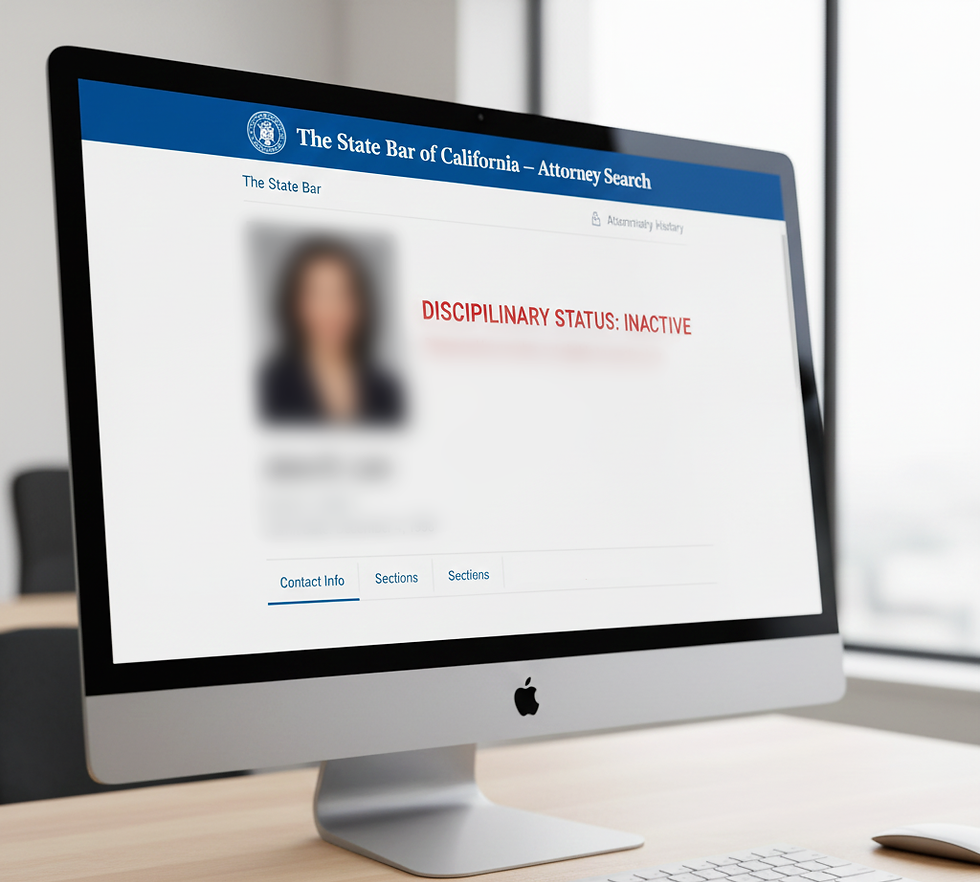
The State Bar of California has officially launched its mandatory CTAPP compliance reviews, shifting from reactive discipline to a proactive "random audit" model that can cost firms up to $25,000...

Schedule a Consultation
Ready to find out how your business having its own Chief Bookkeeping Officer can help?