

We reconcile your trust bank statement, trust journal, and client ledgers each month so your firm stays organized for Rule 1.15 and CTAPP recordkeeping.
If your IOLTA records are scattered, late, or handled inconsistently, that becomes your problem, not your bookkeeper’s.
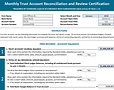
Trust accounting requires precision. Whether your firm manages a few retainers or hundreds of active cases, IOLTA compliance demands clear records and consistent verification. At Chief Bookkeeping Officer, we provide monthly IOLTA 3-way reconciliations following the California State Bar’s record-keeping format, which closely mirrors the requirements used by most other state bars.
What the 3-Way Reconciliation Verifies
An IOLTA 3-way reconciliation confirms that three data points agree:
-
The trust bank balance from your IOLTA bank statement
-
The trust liability balance within your books, which we maintain and reconcile each month
-
The total of all client ledgers showing funds held for each client or matter
In many firms, those individual client ledgers originate from practice management software such as Clio, MyCase, Casepeer, or FileVine. Our team confirms each ledger balance against both the firm’s books and the IOLTA bank statement to ensure all three sources align. This prevents overages, shortages, or commingling, all of which are key compliance risks under State Bar rules.

Specialized Bookkeeping Service Pricing for Law Firms and Their IOLTA Accounts
Handling client trust funds is not the kind of work that should be left to variable hourly billing. Our law firm bookkeeping is offered on a predictable fixed-fee basis, with pricing based on the complexity of your firm and the level of support required. The pricing for monthly IOLTA three-way reconciliation service start at:
$499.00 per month
Our fixed monthly fee may change inline with your firm's matter and transaction volume.
The Components of an IOLTA 3-Way Reconciliation Report

Client Ledgers
Individual client ledgers show how much of the trust balance belongs to each matter or client. When added together, they should equal the firm’s total trust liability.

Bookkeeping Records
The bookkeeping records reflects the trust-related balances recorded in the firm’s liabilities. These records help confirm that the books agree with the trust activity and client-level balances.

Account Journal
The trust account journal tracks all deposits, disbursements, and transfers affecting the IOLTA account. It provides the running activity record that supports the monthly reconciliation.
Why the State Bar Cares About 3-Way IOLTA Reconciliation
California’s Rules of Professional Conduct require attorneys to keep a trust account journal, individual client ledgers, and monthly three-way reconciliations that prove those records match the bank statement. This duty now sits in Rule 1.15, carried forward from the original 1993 trust-account standards.
Under CTAPP, the State Bar can ask for proof at any time. Firms must be able to show:
-
A complete trust account journal for each IOLTA or client trust account
-
Individual client ledgers that show every dollar in and out for each matter
-
Monthly three-way reconciliations with support for outstanding checks and deposits
-
Records retained for at least five years after disbursement
Our job is to keep those records clean, complete, and ready to hand over without a scramble.
How We Handle the Process
Each IOLTA reconciliation cycle includes a full set of working papers and reports formatted for the State Bar. You’re not just getting a spreadsheet; you’re getting a documented trail that shows exactly how every trust dollar has been tracked.
-
The IOLTA bank statement
-
The trust liability report from your books (which we build and maintain)
-
Client and matter-level data from your practice management software
Using the California State Bar’s Excel reconciliation template, we prepare client-by-client ledgers and confirm that totals match the trust and liability balances. Any discrepancies, such as uncleared checks, unrecorded deposits, or balance mismatches, are identified, corrected, and documented.
Integrated with Your Operational Bookkeeping
Our IOLTA 3-way reconciliation service runs alongside your firm’s operational bookkeeping. It can be included as part of your ongoing monthly engagement or added as a separate service for firms that already manage their operational books internally. This flexibility allows your firm to maintain full compliance while keeping day-to-day financial operations simple and structured.
What You Receive From Us Each Month
Each IOLTA reconciliation cycle includes:
-
A completed three-way reconciliation workbook in the California State Bar format, with bank, trust journal, and client ledger totals clearly matched
-
Updated client trust ledgers for every matter with activity that month
-
A schedule of outstanding checks
-
A list of any exceptions or troubleshooting items for the lead attorney's review
A Stronger Foundation for Compliance
The reconciliation process isn’t just about meeting bar requirements, it’s about protecting your clients and your firm. Clean trust records reduce the risk of compliance issues, simplify audits, and build confidence in your financial systems.
For firms that also want to streamline the operational side of their books, our QuickBooks Online Bookkeeping for Law Firms service extends that same structure across operating accounts, retainers, and case costs, ensuring every dollar is accounted for from trust to income.
Partner with one of our CBOs and let our team handle your firm’s bookkeeping and IOLTA 3-way reconciliation each month so you can stay focused on your clients. Schedule a consultation below or call us at 213-286-7502.
IOLTA Accounting Frequently Asked Questions
Law Firm Bookkeeping Resources
Updated March 31st, 2026
Law Firm Bookkeeping Articles and Resources
Schedule a Consultation
Ready to find out how your business having its own Chief Bookkeeping Officer can help?