

Did You Receive a Notice From the California State Bar About Your IOLTA or Trust Account?
Receiving a notice from the State Bar about your client trust account can be stressful, especially if your firm is not sure whether its IOLTA records are complete, current, or properly reconciled. Chief Bookkeeping Officer helps California law firms organize their trust accounting records, review the bookkeeping behind their IOLTA activity, and prepare monthly 3-way reconciliation reports.
Why Is the State Bar Asking for Monthly IOLTA 3-Way Reconciliations?
Monthly 3-way reconciliations are one of the core records California attorneys are expected to maintain for client trust accounts. The State Bar’s CTAPP Compliance Review FAQ lists monthly 3-way reconciliations as required trust account records, along with the account journal, client ledgers, bank statements, check copies, and supporting documentation such as client ledger summaries and lists of outstanding deposits and disbursements.
Disclaimer: Chief Bookkeeping Officer LLC provides bookkeeping and IOLTA reconciliation support only; this page is not legal advice, an ethics opinion, or guidance from the State Bar of California.
A 3-way reconciliation is important because it does more than compare the bank statement to QuickBooks. It should show whether three separate records agree for the same period:
-
The adjusted bank balance
-
The trust account book balance
-
The total of all client ledger balances
When those three numbers do not match, the firm may have missing transactions, uncleared checks, deposits in transit, incorrect client matter postings, or trust liability balances that need to be reviewed.
The State Bar’s own voluntary compliance review findings showed why this matters. Of the 18 firms that completed the voluntary CTAPP pilot process, 83% had noncompliant monthly 3-way reconciliations, 83% had noncompliant trust account journals, and 89% had noncompliant client ledgers.
That means the monthly reconciliation is not just an accounting formality. It is one of the primary records the State Bar may use to evaluate whether the firm is actually maintaining trust account records in a complete and reviewable way.

Monthly IOLTA 3-Way Reconciliation Report

Client Trust Ledger

Trust Account Journal

What Other Questions May Come Up During a CTAPP Compliance Review?
A CTAPP compliance review is not limited to asking whether the bank balance matches. The State Bar has said compliance reviews evaluate trust account recordkeeping practices in several areas, including trust accounting records, notification and distribution time frames, supervision, and accuracy of records.
Based on the California State Bar’s published materials, firms should be prepared for questions such as:
-
Does the firm maintain an account journal for each client trust account?
-
Does the firm maintain client ledgers by client or matter?
-
Are monthly 3-way reconciliations prepared and supported?
-
Are outstanding checks and deposits in transit listed and reviewed?
-
Are clients or third parties notified within 14 days of receipt of funds?
-
Are undisputed funds distributed within 45 days?
-
Are attorney fees supported by invoices, fee agreements, or other documentation?
-
Are earned fees withdrawn from trust within a reasonable time?
-
Does an attorney review or supervise the trust accounting process?
-
Are staff roles and responsibilities clearly defined?
The State Bar’s CTAPP Law Firm Self-Assessment also identifies five broad compliance categories: client trust bank accounts, client trust accounting and funds management, timely communication, disbursements, and supervision.
This is why firms should not wait until a review begins to figure out whether their records are organized. The questions are practical, document-heavy, and often require coordination between the attorney, bookkeeper, bank records, practice management software, and payment processor.
What Records Should Your Firm Start Gathering?
If your firm received a notice, the first step is to identify what records exist and where they are located. Some records may be in QuickBooks. Others may be in the bank portal, LawPay, Clio, Smokeball, PracticePanther, LeanLaw, internal spreadsheets, client files, or old email threads.
The basic record package usually includes:
-
Monthly IOLTA bank statements
-
Check images or canceled check copies
-
Deposit records
-
LawPay or merchant processing records
-
Client ledgers by client or matter
-
Trust account journal
-
Monthly 3-way reconciliation reports
-
Client ledger summary reports
-
Outstanding check lists
-
Deposits in transit lists
-
Fee agreements
-
Settlement statements
-
Invoices or billing records
-
Client communications related to receipt or distribution of funds
The State Bar’s FAQ specifically identifies trust account journals, client ledgers, bank statements with check copies, monthly 3-way reconciliations, records of 14-day notices, deposit and disbursement support, engagement letters, fee agreements, settlement agreements, invoices, billings, and client communications as records relevant to trust account compliance.
If the records are incomplete, scattered, or not prepared monthly, the firm may need a historical reconstruction before it can clearly understand the condition of the trust account.

Our Monthly Law Firm Bookkeeping and IOLTA 3-Way Reconciliation Service
How We Help Law Firms Stay Current Each Month
Our work with law firms is centered around two critical monthly functions: maintaining the firm’s operating bookkeeping and preparing monthly three-way reconciliations for client trust accounts. The operating books keep the business side of the firm current, including income, expenses, bank activity, credit cards, payroll entries, and monthly financial reporting. The trust accounting work focuses on the IOLTA side, including the account journal, client ledgers, bank statement activity, outstanding deposits, outstanding disbursements, and the written monthly reconciliation report.
Together, these services help create a more organized monthly bookkeeping process inside QuickBooks Online. The goal is to keep operating activity current while also maintaining the trust accounting records that attorneys may need to reference for CTAPP reporting, internal review, or future support requests. For firms handling retainers, settlements, advanced costs, or other client funds, that monthly process can make the difference between having records that are easy to review and having to reconstruct trust activity later.

Monthly Bookkeeping Service
We maintain your law firm’s operating account books each month in QuickBooks Online so income, expenses, owner activity, payroll-related entries, and core business transactions are recorded consistently. This helps keep your profit and loss statement and balance sheet current and easier to review.
-
Monthly bookkeeping maintained within QuickBooks Online for the law firm
-
Reconciliation of all financial accounts, including operating, credit cards, IOLTA, and liabilities
-
Categorization of all transactions to ensure consistent and reliable financial data
-
Proper recording of deposits and disbursements to reflect how funds move through the firm
-
Bookkeeping structured to support client trust activity and downstream reconciliation
-
Clear separation between firm funds and client-related activity within the accounting records
-
Monthly preparation of profit and loss statement and balance sheet
-
Ongoing maintenance of clean, current financial records for internal visibility

Monthly IOLTA 3-Way Reconciliation Service
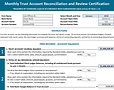
We prepare the monthly 3-way reconciliation reports for your client trust account by comparing the bank balance, client ledger balances, and trust liability in QuickBooks Online. This helps keep trust activity organized and supports a more consistent monthly reconciliation process for firms handling client funds.
-
Monthly preparation of 3-way IOLTA reconciliation using State Bar CTAPP report structure
-
Reconciliation of trust bank balances using official bank statements and transaction detail
-
Alignment of client ledger balances with trust account activity across all matters
-
Tie-out of QuickBooks Online trust liability accounts to total client ledger balances
-
Review and validation of monthly trust account journals for deposits and disbursements
-
Identification of outstanding checks, deposits in transit, and timing differences
-
Creation of a monthly reconciliation report showing agreement across all three components
Updated May 6th, 2026
Schedule a Consultation
Ready to find out how your business having its own Chief Bookkeeping Officer can help?