

Did You Receive an IOLTA Insufficient Funds Activity Letter from the California State Bar?
In FY 2025, California had 738 bank reportable actions involving attorney trust accounts. These matters begin when a bank reports insufficient funds activity in a client trust account, even if the transaction was ultimately honored.
Chief Bookkeeping Officer helps attorneys identify what caused the notice, reconcile the IOLTA records, and create monthly three-way reconciliation reports for review with your ethics counsel.
How Did the State Bar Find Out About the IOLTA Insufficient Funds Activity?
In California, banks and financial institutions report certain insufficient funds activity on attorney client trust accounts to the State Bar. This can happen when a check or other payment is presented against an IOLTA account without sufficient funds, even if the transaction is later corrected or the account is replenished.
The notice does not always mean the attorney intentionally mishandled client funds. It does mean the trust account activity needs to be reviewed, documented, and reconciled carefully.
What Information Does the State Bar Request After an IOLTA Insufficient Funds Notice?
An insufficient funds activity letter usually starts with a few basic questions: what transaction caused the activity, why there were not enough funds available, and what was done to correct it.
The State Bar may ask whether the transaction was a client payment, a settlement disbursement, a vendor payment, or another type of trust account transaction. If the activity involved a client disbursement, the response may need to be supported by settlement records, proof of the related trust deposit, check images, and the affected client ledger.
The letter may also request trust accounting records for the period surrounding the event, including client ledger cards, the trust account journal, and monthly reconciliation reports. Under California Rule of Professional Conduct 1.15, attorneys are required to keep records for client trust accounts, including written ledgers and monthly reconciliations.
In many cases, the State Bar will also ask whether the firm corrected the issue before receiving the letter. That may include proof that funds were replenished, a returned check was replaced, or the affected account was brought back into balance.
More recently, these letters may also ask whether the affected IOLTA account has been consistently reported through the State Bar’s annual CTAPP reporting process.
How Chief Bookkeeping Officer Can Help With Your IOLTA Notice Response
Chief Bookkeeping Officer helps attorneys identify what caused the IOLTA insufficient funds activity and organize the accounting records needed to support the response. Note: We highly recommend consulting with a professional responsibility or ethics counsel as soon as possible.
We trace the transaction, review the affected client ledger, reconcile the trust account activity, and prepare the supporting workpapers for review with ethics counsel. If the records are incomplete, we can help reconstruct the client ledger cards, trust account journal, and monthly reconciliation reports for the period requested.

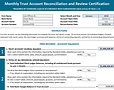
Monthly IOLTA 3-Way Reconciliation Report

Client Trust Ledger

Trust Account Journal

Our Monthly Law Firm Bookkeeping and IOLTA 3-Way Reconciliation Service
How We Help Law Firms Stay Current Each Month
Our work with law firms is centered around two critical monthly functions: maintaining the firm’s operating bookkeeping and preparing monthly three-way reconciliations for client trust accounts. The operating books keep the business side of the firm current, including income, expenses, bank activity, credit cards, payroll entries, and monthly financial reporting. The trust accounting work focuses on the IOLTA side, including the account journal, client ledgers, bank statement activity, outstanding deposits, outstanding disbursements, and the written monthly reconciliation report.
Together, these services help create a more organized monthly bookkeeping process inside QuickBooks Online. The goal is to keep operating activity current while also maintaining the trust accounting records that attorneys may need to reference for CTAPP reporting, internal review, or future support requests. For firms handling retainers, settlements, advanced costs, or other client funds, that monthly process can make the difference between having records that are easy to review and having to reconstruct trust activity later.

Monthly Bookkeeping Service
We maintain your law firm’s operating account books each month in QuickBooks Online so income, expenses, owner activity, payroll-related entries, and core business transactions are recorded consistently. This helps keep your profit and loss statement and balance sheet current and easier to review.
-
Monthly bookkeeping maintained within QuickBooks Online for the law firm
-
Reconciliation of all financial accounts, including operating, credit cards, IOLTA, and liabilities
-
Categorization of all transactions to ensure consistent and reliable financial data
-
Proper recording of deposits and disbursements to reflect how funds move through the firm
-
Bookkeeping structured to support client trust activity and downstream reconciliation
-
Clear separation between firm funds and client-related activity within the accounting records
-
Monthly preparation of profit and loss statement and balance sheet
-
Ongoing maintenance of clean, current financial records for internal visibility

Monthly IOLTA 3-Way Reconciliation Service
We prepare the monthly 3-way reconciliation reports for your client trust account by comparing the bank balance, client ledger balances, and trust liability in QuickBooks Online. This helps keep trust activity organized and supports a more consistent monthly reconciliation process for firms handling client funds.
-
Monthly preparation of 3-way IOLTA reconciliation using State Bar CTAPP report structure
-
Reconciliation of trust bank balances using official bank statements and transaction detail
-
Alignment of client ledger balances with trust account activity across all matters
-
Tie-out of QuickBooks Online trust liability accounts to total client ledger balances
-
Review and validation of monthly trust account journals for deposits and disbursements
-
Identification of outstanding checks, deposits in transit, and timing differences
-
Creation of a monthly reconciliation report showing agreement across all three components
Updated May 6th, 2026
Schedule a Consultation
Ready to find out how your business having its own Chief Bookkeeping Officer can help?