

CTAPP and IOLTA Annual Certification: What California Attorneys Actually Attest To
Each year in March, California attorneys complete CTAPP annual reporting with the State Bar including questions about IOLTA reconciliations, client ledgers, account journals, bank statements, and trust account records. Understand what attorneys actually certify, what records are expected, and where monthly trust accounting can fall short.
What Is the CTAPP Annual Certification?
And why does it matter?
The CTAPP annual certification is part of the State Bar of California’s Client Trust Account Protection Program annual reporting process. Each year, California attorneys complete CTAPP reporting through their My State Bar Profile as part of annual license renewal.
For attorneys with responsibility over client trust accounts, the process can include reporting trust account information, answering self-assessment questions, and certifying compliance with rules related to the safekeeping of client and third-party funds. In plain English, it is the yearly moment where attorneys confirm whether their trust accounting records and practices are actually being maintained.
What Do California Attorneys Actually Attest To For Their IOLTA?
The CTAPP Annual Reporting Questions from the California State Bar.
For attorneys responsible for an IOLTA or other client trust account, the CTAPP self-assessment gets very specific. It asks whether the firm maintains the required trust accounting records: client ledgers, an account journal, bank statements, and cancelled checks.
It also asks whether a written monthly reconciliation is completed and maintained for each client trust account. That reconciliation is supposed to match the bank statement, the client ledger totals, and the account journal.
The real question is whether the records behind the answer are actually there: client ledgers by matter, a complete account journal, bank statement support, cancelled check images, and monthly reconciliation reports that show the three balances agree.
What exactly should attorneys prepare for? Here are some of the questions you need to answer during your annual certification for IOLTA compliance.
Disclaimer: Chief Bookkeeping Officer LLC provides bookkeeping and IOLTA reconciliation support only; this page is not legal advice, an ethics opinion, or guidance from the State Bar of California.
1. Entrusted funds deposited in proper trust accounts
“I affirm that entrusted funds are deposited in trust accounts maintained in the State of California unless there is a substantial relationship between the client or the client’s business and the other jurisdiction and the client agrees in writing, or that the rules and laws of another jurisdiction apply.”
Question 1 asks the attorney to affirm that entrusted funds are deposited in trust accounts maintained in California, unless there is a qualifying reason for the funds to be held in another jurisdiction. This question is especially important for multi-state firms, attorneys licensed in multiple jurisdictions, or matters with clients, businesses, or trust accounts outside California, because the firm may need to determine whether California rules apply, whether another jurisdiction’s rules apply, or whether there is a substantial relationship and written client agreement supporting the account location.
2. IOLTA funds held at an eligible institution
“I affirm that any funds held in an IOLTA account are maintained in an IOLTA-eligible institution identified on the State Bar of California’s website.”
Question 2 asks the attorney to affirm that any funds held in an IOLTA account are maintained at an IOLTA-eligible financial institution listed by the State Bar of California. In plain terms, an attorney cannot simply open an IOLTA at any bank they prefer; the institution must be eligible to hold California IOLTA funds. The State Bar maintains its current list of eligible institutions here: https://www.calbar.ca.gov/access-justice/financial-institutions-banking-compliance/iolta-eligible-financial-institutions
3. Trust account information reported annually and changes reported within 30 days
“I affirm that all client trust account information is reported and registered annually and all changes to trust account information are reported to the State Bar within 30 days in the manner prescribed by the State Bar.”
Question 3 asks the attorney to affirm that client trust account information is reported and registered annually, and that changes to trust account information are reported to the State Bar within 30 days. Those updates are handled through My State Bar Profile under Client Trust Reporting, either as part of CTAPP Annual Reporting during the renewal cycle or through the Rule 2.2(C) 30-day Client Trust Account Reporting option when changes occur outside the annual reporting period.
4. Client funds held in properly labeled trust accounts and kept separate
“I affirm that all client funds or funds entrusted by others to me or to my firm or organization are held in one or more accounts labeled as a ‘Trust Account,’ or similar designation, and are maintained separate from any accounts held by me, by other individual attorneys in my firm/organization, or by the firm/organization that primarily hold personal or business funds.”
Question 4 asks the attorney to affirm that client funds, or funds entrusted by others, are held in one or more accounts clearly labeled as a “Trust Account” or similar designation, and that those funds are kept separate from personal, business, or firm operating funds. In plain terms, this question is about segregation: client trust money should not be mixed with the attorney’s personal money, the firm’s operating account, or any other account primarily holding business funds. This could be accomplished by including "IOLTA" or "Trust Account" or similar naming conventions as the account holder business name with your ceritifed financial institution.
5. Required trust accounting records are maintained
“For each client trust account maintained by me or my firm or organization, all the following records are maintained: Client Ledger, Account Journal, Bank Statements, Cancelled Checks.”
Question 5 asks the attorney to affirm that the required records are maintained for each client trust account: client ledgers, an account journal, bank statements, and cancelled checks. This is one of the most bookkeeping-heavy questions in the CTAPP self-assessment because these records are the foundation for proving what happened in the trust account. The client ledger shows how much belongs to each client or matter, the account journal shows all trust activity in chronological order, the bank statements show what actually cleared the bank, and cancelled checks support the disbursements that left the account. Without these records, it becomes very difficult to prepare a complete monthly reconciliation or explain the trust balance later.
6. Written monthly three-way reconciliation is completed and maintained
“I affirm that a written, monthly reconciliation of the bank statement, client ledger, and account journal are completed and maintained for each client trust account.”
Question 6 asks the attorney to affirm that a written monthly reconciliation of the bank statement, client ledger, and account journal is completed and maintained for each client trust account. The State Bar’s CTAPP resources include a monthly reconciliation report that compares the trust account journal balance, the total of all individual client ledger balances, and the adjusted bank statement balance. The report also contemplates supporting schedules for outstanding deposits and outstanding disbursements, along with the bank statement, check copies, account journal, individual ledgers, and client ledger summary. In practical terms, this is the written three-way reconciliation record that shows whether the trust account is actually reconciled for the month.
7. Timely accounting reports are provided to clients or other interested persons
“I affirm that timely reports are provided to clients or other persons accounting for funds, securities, or other property held in their name, including deposits, withdrawals, and other transactions.”
Question 7 asks the attorney to affirm that timely accounting reports are provided to clients or other interested persons for funds, securities, or other property held in their name, including deposits, withdrawals, and other transactions. In plain terms, this question is about whether the firm can account to the client or third party for what happened with their money, not just whether the firm knows the overall trust account balance. The records behind this answer usually come from the client ledger, which should show the activity and current balance for that specific client or matter.
8. Advance fees/costs are held in trust unless an exception applies
“If a fee agreement involves advances for costs, expenses, or fees, including flat fees, such funds are held in a client trust account prior to being expensed or earned, unless subject to an exception.”
Question 8 asks whether advance fees, costs, expenses, or flat fees are held in a client trust account before they are earned or spent, unless an exception applies. In plain terms, this question is about whether the firm is properly separating money that still belongs to the client from money the firm has already earned or is entitled to use. For bookkeeping, this usually turns on how retainers and advance cost deposits are recorded, whether they are posted to the client’s ledger, and whether funds are moved out of trust only when fees are earned, costs are incurred, or another permitted exception applies.
9. Earned firm funds are withdrawn at the earliest reasonable time
“I affirm that, absent an exception, funds belonging to me or my law firm or organization are withdrawn from client trust accounts at the earliest reasonable time once the fees, or a portion thereof, become fixed and earned.”
Question 9 asks the attorney to affirm that funds belonging to the attorney or law firm are withdrawn from the client trust account at the earliest reasonable time once the fees, or a portion of the fees, become fixed and earned. In plain terms, this question is about not leaving earned firm money sitting in trust longer than necessary. It focuses on whether the firm is timely moving earned funds out of trust once those funds no longer belong to the client.
10. Firm funds in trust are limited to bank charges/service fees
“I affirm that funds belonging to me or my firm or organization that are held in the client trust account are funds that are no more than reasonably sufficient to pay bank charges or service fees… and other undisputed funds belonging to me or my firm or organization are withdrawn at the earliest reasonable time under rule 1.15(c)(2).”
Question 10 asks the attorney to affirm that any firm funds held in the client trust account are limited to an amount reasonably sufficient to pay bank charges or service fees, and that any other undisputed funds belonging to the attorney or firm are withdrawn at the earliest reasonable time. In plain terms, the trust account should not be used as a place to park firm money, except for the limited amount needed to cover allowable bank charges.
11. Client funds are not used for IOLTA bank charges
“I affirm that client funds are NOT used to pay for bank charges or service fees in a California IOLTA.”
Question 11 asks the attorney to affirm that client funds are not used to pay bank charges or service fees in a California IOLTA account. In plain terms, this question is about making sure bank fees are not reducing money that belongs to clients or third parties. If bank charges are expected, the firm generally needs to handle those charges with permitted firm funds rather than allowing client balances to absorb them.
12. Clients are notified of received funds within 14 days absent good cause
“I affirm that, absent good cause, clients or other persons with an interest in funds, securities, or other property received are notified about the receipt of the funds, securities, or other property no later than 14 days after receipt.”
Question 12 asks the attorney to affirm that, absent good cause, clients or other persons with an interest in funds, securities, or other property are notified no later than 14 days after the attorney receives those funds, securities, or property. In plain terms, this question is about timely notice: when money or property arrives for a client or third party, the firm should not let it sit without informing the people who have an interest in it.
13. Disputed funds stay in trust until resolved
“If a dispute arises as to rights to any funds I hold in trust for clients or other persons, I affirm that the disputed portion of these funds are not withdrawn until the dispute is resolved.”
Question 13 asks the attorney to affirm that if a dispute arises over funds held in trust for a client or another person, the disputed portion is not withdrawn until the dispute is resolved. In plain terms, this question is about protecting contested funds: if there is a disagreement over who is entitled to the money, the disputed amount should remain in trust while the issue is worked out.
14. Policies, procedures, training, and supervision are in place
“I affirm that policies and procedures, including training and supervision practices, are in place and are followed to ensure that client trust accounts are
maintained consistent with the California Rules of Professional Conduct and applicable law…”
Question 14 asks the attorney to affirm that policies and procedures are in place and followed, including training and supervision practices, to help ensure client trust accounts are maintained consistent with the California Rules of Professional Conduct and applicable law. In plain terms, this question is about whether the firm has an actual system for trust accounting, not just a bank account. That can include who handles trust deposits and disbursements, who reviews reconciliations, how records are maintained, how staff are trained, and how attorneys supervise the process.
The Annual Certification of Compliance:
Step 4 is where the attorney certifies whether they are knowledgeable about and in compliance with the rules and statutes governing client trust accounts and the safekeeping of funds entrusted by clients and others.
For attorneys responsible for an IOLTA or other client trust account, that certification comes after the self-assessment questions about trust account records, monthly reconciliations, client ledgers, account journals, bank statements, cancelled checks, timely client notice, disputed funds, and supervision practices.
The certification is broad, but the recordkeeping behind it is specific. If the firm is answering “yes” to the self-assessment, the monthly reconciliation packet should exist and should be able to show how the bank statement, client ledger totals, and account journal agree.

The Final Declaration: A Checkbox with Real Consequences
The final declaration is signed under penalty of perjury. The attorney is confirming that the CTAPP reporting was personally completed and that the information provided is true and correct.
For attorneys responsible for IOLTA accounts, that statement can reach the underlying trust accounting records, including monthly reconciliations, client ledgers, account journals, bank statements, and supporting records.


How Can You Tell Your Law Firm Needs IOLTA 3-Way Reconciliations?
Ask your bookkeeper or accountant: "Can you produce these reports each month?"
Most law firms assume their trust accounting is in good shape until someone asks for the actual records. For IOLTA purposes, a bank reconciliation by itself is not the full picture. A stronger test is whether the firm can produce the core monthly trust accounting records: an account journal, client ledgers by matter, and a written monthly reconciliation report showing that the bank statement, client ledger total, and account journal agree.

Monthly IOLTA 3-Way Reconciliation Report
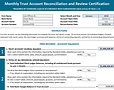
This summary brings together the adjusted bank balance, total client ledger balances, and trust liability recorded in QuickBooks Online. It shows whether all three components are in agreement for the month. This is the report that ties the full reconciliation together.

Client Trust
Ledger
The clientledger tracks trust activity for each individual client or matter, including deposits, disbursements, and remaining balances. It shows how much of the total trust balance belongs to each client. This report helps support the full trust balance with client-level detail.

Trust Account
Journal
The account journal shows all deposits, disbursements, and transfers moving through the IOLTA account during the period. It serves as the transaction history for the trust account. This report helps connect the bank activity to the client ledgers and reconciliation.

Monthly Law Firm Bookkeeping and IOLTA 3-Way Reconciliation Service
How We Help Law Firms Stay Current Each Month
Our work with law firms is centered around two critical monthly functions: maintaining the firm’s operating bookkeeping and preparing monthly three-way reconciliations for client trust accounts. The operating books keep the business side of the firm current, including income, expenses, bank activity, credit cards, payroll entries, and monthly financial reporting. The trust accounting work focuses on the IOLTA side, including the account journal, client ledgers, bank statement activity, outstanding deposits, outstanding disbursements, and the written monthly reconciliation report.
Together, these services help create a more organized monthly bookkeeping process inside QuickBooks Online. The goal is to keep operating activity current while also maintaining the trust accounting records that attorneys may need to reference for CTAPP reporting, internal review, or future support requests. For firms handling retainers, settlements, advanced costs, or other client funds, that monthly process can make the difference between having records that are easy to review and having to reconstruct trust activity later.

Monthly Bookkeeping Service
We maintain your law firm’s operating account books each month in QuickBooks Online so income, expenses, owner activity, payroll-related entries, and core business transactions are recorded consistently. This helps keep your profit and loss statement and balance sheet current and easier to review.
-
Monthly bookkeeping maintained within QuickBooks Online for the law firm
-
Reconciliation of all financial accounts, including operating, credit cards, IOLTA, and liabilities
-
Categorization of all transactions to ensure consistent and reliable financial data
-
Proper recording of deposits and disbursements to reflect how funds move through the firm
-
Bookkeeping structured to support client trust activity and downstream reconciliation
-
Clear separation between firm funds and client-related activity within the accounting records
-
Monthly preparation of profit and loss statement and balance sheet
-
Ongoing maintenance of clean, current financial records for internal visibility

Monthly IOLTA 3-Way Reconciliation Service
We prepare the monthly 3-way reconciliation reports for your client trust account by comparing the bank balance, client ledger balances, and trust liability in QuickBooks Online. This helps keep trust activity organized and supports a more consistent monthly reconciliation process for firms handling client funds.
-
Monthly preparation of 3-way IOLTA reconciliation using State Bar CTAPP report structure
-
Reconciliation of trust bank balances using official bank statements and transaction detail
-
Alignment of client ledger balances with trust account activity across all matters
-
Tie-out of QuickBooks Online trust liability accounts to total client ledger balances
-
Review and validation of monthly trust account journals for deposits and disbursements
-
Identification of outstanding checks, deposits in transit, and timing differences
-
Creation of a monthly reconciliation report showing agreement across all three components
Updated May 2nd, 2026
Schedule a Consultation
Ready to find out how your business having its own Chief Bookkeeping Officer can help?